|

This page updated
Saturday, March 28, 2026
| |
|
|
|
In the 1960s and 1970s,
Louisville, Kentucky was the scene of one of the hottest radio battles in the
country: Top 40 station
WAKY vs. Top
40 station WKLO. This Website is dedicated to the fans and former
employees of "The Big 1080: Radio WKLO."
(For WAKY lovers, go
here.) Thanks for
visiting! |
|
August 25, 2019
Audio collages (produced by Rip
Rinehart & Lonnie Griesbaum and voiced by Gary Major) for nearly all the WKLO Toys for
Concerts have been added here.
Rewound Radio's August 18, 2019 WKLO
jingle spotlight has been added here.
February 21, 2018
Former GM Ernie Gudridge checked in to
recognize four special Radio WKLO employees
here.
May 22, 2017
Added new photos and upgraded others.
April 24, 2017
We've done a pretty significant
overhaul of the WKLO Photo Pages. This
included adding new pics, improving the look of existing images and
doing a bit of reorganization.
August 23, 2016
Thanks to Carl Blanton for the 1969
studio pics of Bill Bailey two days before he left WKLO. Find them
on this page.
Former WKLO announcer Ted Barbone's
obituary has been posted here.
November 27, 2015
Several WKLO
surveys from 1970, 1971 and 1972 have been added, courtesy
Phillip Davidson. We've also added and updated .zip files on the
WKLO surveys page to make it easier to download a year or more's
worth of surveys at a time.
Old "What's New" Items
|
|
|
|
|

We invite you to check out our
LKYRadio.com
as well!
LKYRadio.com salutes other
classic Louisville radio stations.
 |
|
On this site you'll find WKLO material
from our personal collection, plus audio, images and information
contributed by former WKLO employees and listeners. Do you have any WKLO
material or information you'd like to make available to this
project?
Please
contact us.
We'd be honored to
accept additional airchecks, photos, surveys and other pieces of
historic data to share with our visitors.
Thanks to all who've helped
preserve the memory of the "Big 1080"! --
John Quincy, Curator |
|
From Billboard Magazine - July 13, 1959
Another recent format change took place at WKLO, Louisville, Ky.,
which introduced a new "Modern Format" July 4. The new format, an
around-the-clock pop music plan, involved the hiring of new
deejay-program director Barney Groven (formerly with KFDA, Amarillo,
Tex.) and new jocks Jim Dixon, KSYD, Wichita Falls, Tex.; Paul
Crawford, ex-KRGV, Weslaco, Tex.; Jack Grady, formerly with
KSYD, Wichita Falls; and Chuck Irvin, another ex-KFDA, Amarillo,
Tex. staffer. Long-time WKLO jock Paul Cowley will be heard from
7-10 p.m. nightly while other veteran WKLO jocks Tommy Downs and
Jimmy Lloyd split the midnight to 6 a.m. shift. |
|
WKLO-WAKY 2006 Reunion Review Page
|
|
"As the manager who hired Mitch
Michael, Bill Hennes, Bill Bailey and many more from 1964-1976, I am
naturally most interested in your efforts to tell the WKLO story,
and very pleased. WKLO was a unique station that combined a great
rock format with some terrific personalities, plus deep interaction
with our younger listeners, and some genuine community service, all
done with a lot of fun." - Ernie Gudridge, Fort Myers,
Florida
"...we should not short change
Ernie Gudridge. Peter Drucker says: 'No enterprise can be more
successful than its management...' Ernie was the strong management
that allowed me to spread my wings, and also was able to correct me
when necessary without ever diminishing my enthusiasm...and, he's
the one who had the wisdom and courage to withstand the initial
dismay of staff, sellers, and advertisers when [Bill] Bailey came on
the scene. Few general managers of that day, most of whom
would have been concerned primarily with sales at the expense of
programming, would have understood, been as supportive or had the
wisdom and foresight of Ernie." - Terrell Metheny (Mitch
Michael), Van Buren, Arkansas (WKLO Program Director 1964-1968) |
|
 |
|
 |
|
'KLO
Comments from Allen Bryan (March, 2005)
My
tenure at WKLO was from 1960-1972, so I worked there before, during,
and after the Terrell Metheny years. My memory of the
competitive situation is different than his and I have a Hooper
rating sheet to substantiate mine. In the pre-TM days, WAKY and WKLO
were 1 and 2 in the market. Although WAKY was consistently number 1
overall, WKLO was strong in the mornings and mid-day. WAKY was the
leader in PM drive and at night. One important fact about WKLO at
night is that we had a very restricted signal pattern that was
imposed at sundown. We probably lost half of our coverage area at
night. Sometimes the signal was hard to get in parts of Jefferson
County. During that pre-Terrell period, all the rest of the radio
stations were tied for last place after WKLO and WAKY and had shares
that are similar to today's market (5-10%).
The architect of the early WKLO period was a guy named Barney
Groven, who was PD when I got there in May of '60, and was still
there when I was drafted and went to the Army in December of '61. In
the 2 years I was gone there was a big turnover including the GM,
Barney, and most of the jocks. Ken Rowland, who had been news
director, was named PD. During that period in '62-'63 they may have lost a lot of
ground with WAKY, but when I came back from the Army in December of
'62, Barney Groven was back, and they were competitive again. (Ken
was a fine News Director, had a long career in local TV news, and
was recently named to the Kentucky Journalism Hall of Fame.)
There's no question that the arrival of Terrell was the key to the
greatest period of success at WKLO in the mid and late '60s. There is
also no question that TM put his stamp on virtually every aspect of
the on-air sound of the station. While he was able to recruit some
very good talent, there was a lot of turnover (mostly guys going to
better gigs), but the success was in the format. As Terrell noted in
his interview, even the great unique style of Bill Bailey was
successful because it was captured within the format, and Bill
learned how to suspend his train of thought in his stories between
records, commercials, newscasts, etc.
One of the greatest conflicts that happened when TM arrived was the
conflict between a news-dominated station and a music-and-format
oriented PD. The evolution of the news product under his PD-ship was
very interesting, and I was on the front line of that evolution as
News Director. I think it helped that I had been a DJ and was much
more interested in sound and format issues than Ken Rowland had
been. I always thought of Ken as being from the Walter Cronkite/Ed Murrow school of broadcast journalism.
Prior to TM, WKLO was a news-dominated station. Our AM and PM drive
times were essentially all news and commercials. Not much music. We
did 2 five-minute newscasts per hour during AM and PM drive. We had no real
limits on the number of commercials. We ran as many as the sales
staff could sell. The sales department also took precedence over
programming in things like remote broadcasts. If they sold it, we
did it -- regardless of how it affected the format.
When TM showed up, his first priority was the stuff between the
newscasts. It took a little longer to start working on the news
on-air sound. I could talk about the changes for hours, but will
save that for later. Lots of changes occurred in the presentation of
the news on the air.
Regarding the
TM memos, I was interested in his references to the news.
It was obviously a high priority, and newsmen had the right of way
when it came to traffic reports and breaking news. News was a vital
element of WKLO's success. I never actually saw those memos at the
time, but I knew what the policy was about the newsman's authority
to get on the air. Another interesting thing about this from a
programming flow point of view is that the DJs had to always be
very quick and flexible in changing course to accommodate the news
guy. Some of them resented it and were pretty ugly about it,
essentially trying to intimidate the newsman to keep him off the
air, but most of them followed the format and were very
accommodating.
For the newsman...especially in drive time with two newscasts an
hour...it was a very busy and hectic routine. This was especially
true in afternoon drive when there were a lot more traffic condition
reports, and a lot more breaking news. The PM drive news shift was
very demanding both physically and mentally. During one period where
I was working on a new style of writing and delivering the news, I
would often go into a PM drive newscast without any typewritten
copy. My stories were mostly handwritten notes with the bare facts
of the story which I would adlib around. Only there was nothing
about it that sounded adlibbed. It was quick paced, and tight.
One of the most unusual experiences I had was when we moved to 307
W. Walnut, Terrell decided that he wanted me, as News Director, to
share an office with him. I think he thought this would help
integrate news and programming. There was some benefit, but
eventually he decided it wasn't working, because he needed the
privacy to talk with jocks, make phone calls, etc. So we eventually
split.
During the years I was with WKLO, I started as the 6p-12m newsman,
moved to doing afternoon drive news and the 9a-12n DJ show at the same
time, then to nighttime teen DJ, then back to news, and then I was appointed
News Director. I worked morning drive doing news with Bill Bailey for
a couple of years, then went off the air as Sales Marketing Manager, then
a dual role as Manager of News and Information which included the
news department. I finally left in December of 1973 to go to work
for the Mayor of Louisville. I never went back to radio after that.
Even
though it was 30-40 years ago, it was still probably one of the most
interesting and exciting times of my life...and I was young enough to
enjoy it. However I always approached my work as a
professional....not as a kid in a candy store...because my dad had been
in radio all of my life, and this was a profession, not a game.
It has been great in the past few years to reestablish contact with
some of the guys I worked with and to realize that we all agree how
special the WKLO experience was.
I
totally agree with what Terrell Metheny wrote about Ernie
Gudridge...he was by far the best boss I ever worked for (other than
my Dad) anywhere in any situation in my 50 years in the workplace.
He gave me many opportunities to do different things at WKLO, and
was always supportive and at the same time he demanded excellence.
|
|

'KLO Comments from the late Mike Rivers (August 14, 2003)
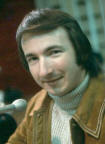
Back
in the early to mid 70's, we sped up the tables at WKLO, Louisville
by 4% (exactly a half-tone). The turntables we used didn't have a
pitch control, so we had to manually lift the platters off and put a
precisely measured length of 1/4" splicing tape around the 45 rpm
section of the turntable capstan. This increased the size of that
part of the capstan just enough to pitch it up 4%. I also have
perfect pitch, so this little assignment was left to me. I'd have to
replace the capstan tape about once a month.
The one song I remember really benefiting from this treatment was
"Rocking Pneumonia and the Boogie-Woogie Flu" - at normal speed it
seem to really drag. Up 4% and it cooked.
Our chief competition, WAKY never did speed theirs up, but I knew
some of their staff and they always complained about how the music
sounded "so much better" on our station than on theirs. I don't
think they had anyone over there with ears keen enough to figure out
what we were doing. We also varisped-up our jingles by 4% as well,
so there wouldn't be a pitch-clash.
WAKY
purchased The Last Contest from Jack McCoy of KCBQ in San Diego.
KCBQ was extremely well-known for, among other things, "the shotgun
jingle" which TM distilled from this package. So when we culled our
OWN shotgun out of the package and used it against WAKY, THAT was
what stirred the pot. Of course, there wasn't anything TM or anyone
else could do about it - we'd BOUGHT the package back in its heyday.
BTW, you'll remember that WKLO ran a promotion against The Last
Contest - and won the ratings period - whereby we gave away cheesy
little $2.00-a-pop plastic chess sets and Bobby Fischer paperback
books on chess vs. all the prize packages they were "offering." But
Willie Hennes had me cook up a bunch of Jack McCoy-style
promos that were better than the prizes themselves - which
effectively blurred the waters enough that our superior air staff
was able to win the book for us.
Of course, The Last Contest was a success for WAKY in that it was
actually a self-liquidating merchandising promotion whereby tons of
sponsors paid to be a part of it and only one had to kick in an
actual prize, since the contest had only one winner at the end. WAKY
made money on it, but we won the war. Hennes played that one
beautifully!
Sheesh. If only it could be so much fun today.
Mike Rivers (Real Name: Ralph W. Wright, Jr.) passed away September
13, 2004. |
|
 |
|
About the Curator |
|
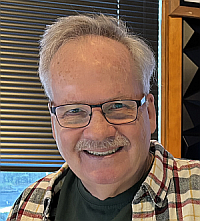
Even though he was born 15
years earlier, Lexington, Kentucky native John Quincy didn't really
discover Top 40 radio until he smuggled in a transistor radio to a
church camp outside of Louisville in the summer of 1970. After a few
hours of listening to the legendary
WAKY (WKLO's
main competition) in his dorm room, he caught
the radio fever. Upon his return to Lexington and a visit to local
stations to find out how radio stations really performed that on-air
magic, he was hooked.
Shortly thereafter a high school
teacher told
him about a Junior Achievement program being sponsored by WVLK-AM.
Every Wednesday night WVLK would turn over a half hour of their
programming to high school kids, who would sell, operate, and
program it. Quincy made sure he was one of the ones chosen to be one
of the teen DJs. Between his junior and senior year
of high school, Quincy scored a summer job
working seven days a week at WBGR AM & FM in Paris, Kentucky. Most
of the time was spent running the board for Cincinnati Reds baseball games, but for
part of each shift he got to play DJ. While it was country music
(which was especially bad in the early '70s), it was radio. From
that point, Quincy never looked back.
There were stints in other Lexington area radio stations (WEKY,
WAXU, WCBR, WKDJ, and WBLG) before Quincy got the call in 1979 to
escape Lexington's awful winters and work in sunny Savannah, Georgia
(WKBX and WZAT). Then in 1981, Quincy moved up the coast to
Charleston, South Carolina to take on PM drive duties at rock
station WSSX. Later Charleston
gigs included AC WXTC (where he spent nearly 10 years as PD), All
70s WJUK, Country WBUB, Oldies WXLY, News-Talk WTMA, and Country
WNKT. Subscribers
to Tom Konard's
Aircheck Factory service might remember Quincy
as one of the narrators of "Around The Dial" and various profiles.
In December 2024 Quincy
retired as the
Program Director and Morning Host at
News-Talker WTMA
in Charleston. He can still be heard occasionally playing
Kentuckiana's Greatest Classic Hits on
WAKY-FM in the
Louisville, KY area.
Along with his radio work, he creates and maintains Web sites including tributes to Charleston radio stations
WCSC,
WTMA and
WOKE, as well as pre-1990s
Louisville and
Lexington, Kentucky radio. |
|
Cool Links |
|
JingleSamplers.com
LKYRadio.com (Louisville and Lexington Radio Tribute
Site)
WAKY, Louisville
Tribute Site
WCSC, Charleston
Tribute Site
WOKE,
Charleston Tribute Site
WQAM, Miami Tribute Site
WTMA,
Charleston Tribute Site |

|